Home Newsletter -  |
 |
Welcome to CaribVET, the website of the Caribbean Animal Health Network!
This website aims at disseminating information on the animal health situation in the Caribbean and providing useful resources for animal health professionals. If you want to know more about the network, click on CaribVET in the menu banderol. If you want to get an overview of the surveillance network in a country, click on Surveillance. |
| - HEALTH NEWS - | • Influenza A/H1N1 in swine, Argentina
After Canada, this is the second outbreak of Influenza A/H1N1 in a pig farm. Experimental data on pig infections with this strain indicate that infection is localised to respiratory tract and that viraemia is highly unlikely to be of any significance as one of the feature of the disease. See the preliminary outbreak assessment by DEFRA and the OIE report. OIE maintains that previous recommendations for OIE member countries remain valid.
• Influenza A(H1N1)
Flu pandemic alert raised to phase 6 11 June 2009 -- On the basis of available evidence and expert assessments of the evidence, the scientific criteria for an influenza pandemic have been met. The Director-General of WHO has therefore decided to raise the level of influenza pandemic alert from phase 5 to phase 6. As of 29 Jun 2009, 55 766 confirmed cases of the new influenza A (H1N1) virus, including 311 deaths, have been notified in 29 countries of the Americas. There is no risk of infection from this virus from consumption of well-cooked pork and pork products (see the joint FAO/WHO/OIE statement). The virus is new and is transmitted from human to human without known history of contact with swine. The OIE strongly counsels against the culling of pigs in the current situation. Veterinary Authorities should work in collaboration with human health counterparts to monitor pig herds for any signs of unusual illness with suspected linkages to human cases of A/H1N1 influenza. See the OIE statement, 27/04/09. Check updated information on the CDC website, the WHO website, and the Promed website.
For more information click on "disease" and then "H1N1 Influenza" or go direct on the caribvet specific web page . Do not hesitate to share any document produced in your country which could be useful for the region: communication documents, national recommendations, technical protocols. To provide these documents send an email to caribinfo@caribvet.net with your authorization to post them on CaribVET website.
• H7 Low Pathogenic Avian Influenza outbreak in Kentucky (USA)
A minimal drop in egg production in a single farm was noticed in mid-March 2009. Testing by the National Veterinary Services Laboratory in Ames, Iowa resulted in a confirmed positive finding for the H7 strain. No virus has been isolated, and no poultry deaths have been found in connection with the infection. The company plans to depopulate 20 000 chickens in 2 houses on the farm. The Kentucky Department of Agriculture is conducting surveillance on backyard flocks within a 2-mile radius of the farm. Click here to see the OIE report.
• First human rabies death in the USA since 1959
State health officials report Missouri's first human death from rabies in nearly a half-century. The victim died Sunday 30 Nov 2008, about 6 weeks after he was bitten by a bat. The Centers for Disease Control and Prevention confirmed positive and typed as a variant of the rabies virus associated with silver haired and eastern pipistrelle bats. promed report; press release
• Virulent Newcastle Disease outbreak in Belize
The outbreak occurred in the Cayo District in a commercial broiler and layer farm, and in two nearby broiler and layer farms, involving 29.500 birds. All infected premises have been depopulated. Ames national veterinary services laboratory confirmed that poultry samples submitted from Belize were positive (RRTPCR) for virulent Newcastle disease, an OIE listed disease. More information about this event are available in the BAHA press release and on the OIE report. Updates on the situation with the promed articles of the 01/01/09, the 24/01/09, the 28/01/09 and the 29/01/09.
• OIE declara a DR libre de Fiebre Aftosa sin vacunacion
La Organización Mundial de Sanidad Animal, el 30 de Mayo del 2008, adopta la resolución que incluye a la República Dominicana en el grupo de países Libres de Fiebre Aftosa Sin Vacunación. Con esa resolución de alcance y reconocimiento internacionales, el país queda en mejores y ventajosas condiciones para exportar productos y derivados bovinos a todo el mundo, por el prestigio que da el reconocimiento y la certificación obtenidos.
• West Nile seroconversion on horses in Guadeloupe
Seroconversion for West Nile on equines was discovered during the annual sentinel study implemented in 7 areas considered to be at risk for West Nile virus. Seroconversion are thought to have occurred between August 2007 (date of the last negative tests for these equines) and April 2008. The source of infection is unknown and could be related to either an increase in circulation of WNV or to a new introduction. See Promed post
| | More >> | |
|
| - EVENTS - | • 7th International Symposium on Avian Influenza, Athens USA, April 5-8 2009
The symposium focused on poultry and wild birds including virus reservoirs and ecology, vaccines and diagnostics, phylogenetics and molecular epidemiology, risk assessment, national and international control strategies, updates on recent highly pathogenic avian influenza outbreaks and impact on human health with a focus on occupational and exposure risks. The Avian Influenza CaribVET working group took this opportunity to gather and discuss these topics at the Caribbean level, in particular concerning fighting cocks issue, laboratory network/satellites, policies, emergency preparedness plans and response. Discussions concerned as well the regional surveillance protocol, the priorities and the projects for the region.

• CaribVET Network Meeting, Jamaica, March 2009
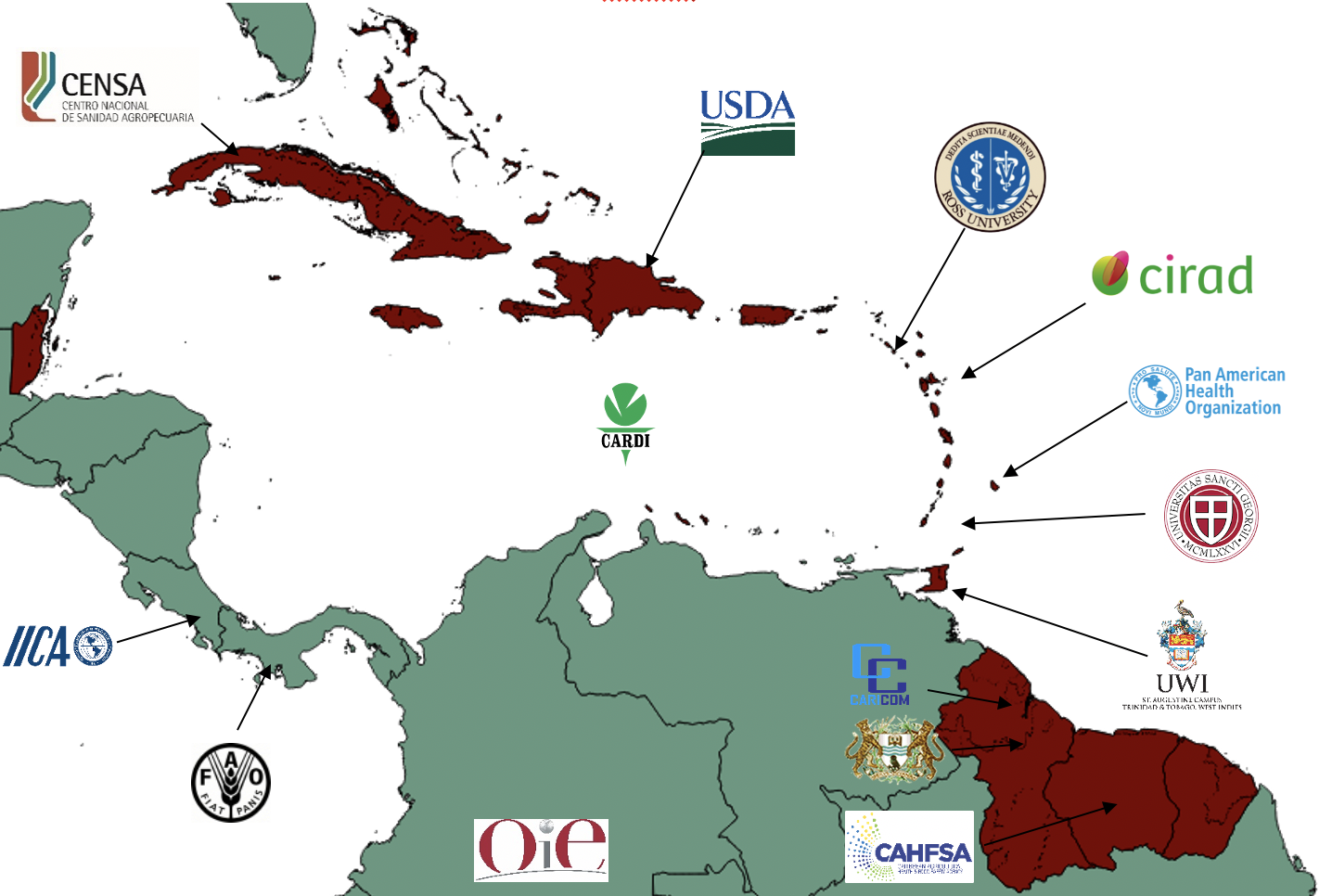
The CaribVET Steering Committee, the Epidemiology Working Group, the CARICOM Chief Veterinary Officers and the Veterinary Epidemiologist / Para-epidemiologist (VEP) Programme held a series of meetings in Trelawny Jamaica from 16 -20 March 2009. These meetings were held in collaboration with CARICOM, CIRAD and USDA. There were representatives from the CARICOM members and affiliated States, IICA, PAHO, FAO, OIE, the collaborating Agencies as well as the Universities of the West Indies and Guyana. These meetings intended to guide, inform and make decisions about issues related to animal disease surveillance and control throughout the Caribbean Region. Click here to see the presentations of the steering committee.
• Meeting of the CaribVET epidemiology working group in Cuba, December 2008
The "epigroup" met for the third time during a 5 day working session, with the support of CENSA. Risk analysis was the main topic of the meeting, with courses on Qualitative Risk Analysis and proposition of applications in the region. The risk of Fighting Cocks movements was assessed by a preliminary survey which will continue to be carried out. The Cuba geographical risk analysis system was also presented and adaptations were proposed for other Caribbean countries. A presentation of the last 7 SNAT missions implemented by the group members in the VEP countries allowed for the discussion within the whole epigroup of the recommendations proposed for the improvement of national surveillance systems. Click here to obtain more details about the meeting.
• VEPs attend Live Bird Marketing System Training Course
A Live Bird Marketing System - LBMS - continuing education training course was held in Storrs, Connecticut, August 19–21, 2008. Topics covered included national surveillance of Avian Influenza in poultry, proper sampling techniques, biosecurity, use and application of Global Positioning System - GPS - devices, and cultures of various LBMS. To get more information about this training, click here
• Barbados veterinary services receive special achievement in GIS award
This award has been received by Bryan Sanford during the annual ESRI international user conference held in San Diego, California. B.Sanford works in the Barbados Veterinary Services and is a member of the CaribVET working group of epidemiology experts. He was the database manager of the Caribbean Amblyomma Programme. To see all the presentations of the meeting and get other information about GIS softwares, forums, online trainings... go to ESRI website.
| | More >> |
|
|